

YachtPushr — Industry Intelligence
Yacht Broker Marketing

Marketing for yacht brokers that starts with your listings.

Digital marketing for yacht brokers mostly comes down to getting every listing in front of buyers more than once and publishing the buyer and seller advice that makes owners want to list with you. YachtPushr does that work for a brokerage. It syncs your listings, writes posts from their specs, drafts the articles and shows you what’s bringing people in, and nothing goes out until you approve it.

JR By James Rissler Updated
The listing problem

Every listing deserves more than one post.

Most listings get one post. A boat comes on the market, someone posts it once, and the office moves on to the next one. Buyers take months to make up their minds, though, and most of them never see that one post.

Owners thinking about selling are watching too. They notice which brokers keep marketing the boats they already have, and a brokerage that shows up every week with good listing posts and useful advice looks like the one to list with. Your marketing ends up being part of your listing pitch whether you plan it that way or not.

The trouble is time. Writing up specs, picking photos and posting to a few platforms for every boat adds up to hours a week, and it’s the first thing to slip when deals are closing. That’s the work YachtPushr takes off your plate.

Built for brokers

What YachtPushr does for a brokerage.

YachtPushr is software built for yacht brokerages. You fill in your company profile once - the boats you sell, your market and the buyers and sellers you work with - and everything it suggests and writes starts from that.

  1. 01

    It pulls in your inventory

    YachtPushr syncs your listings from your MLS with their specs and photos. We very likely already connect to your MLS, and if not, we build that for you. You can also add boats by hand. Inventory Sync & Listing Posts goes through how it works.

  2. 02

    It writes posts from your listings

    Pick a boat and YachtPushr writes the post from its specs and description, then posts it with the boat’s photos. Listing posts go out across your social media, including carousels and video.

  3. 03

    It drafts buyer and seller articles

    Long-form articles about buying, selling, surveys, sea trials, pricing and ownership, written in your brokerage’s tone. Custom Ideas like Buyer Guidance and Seller Guidance keep new topics coming.

  4. 04

    It publishes on the dates you pick

    Approved articles go to your WordPress site or into any site through our API. General posts go out across your social media too.

  5. 05

    It shows you what's working

    Site Analytics shows what people find you for on Google, in plain English, and flags the searches that are close to page one. Social Media Analytics shows which posts get views, shares and saves.

  6. 06

    It tells you what to focus on

    Weekly Intelligence looks at your company profile, your Custom Ideas and your latest social media performance, then gives you a recommended focus and a short list of next steps each week.

What to publish

Content that helps sell boats.

A brokerage feed that sells boats mixes listings with what you know. YachtPushr drafts all of these, and you decide which ones go out.

Listing posts

New boats on the market, with the details buyers care about and good photos. A boat that’s been listed a while should get another post with a different angle.

Buyer guidance

What to look for, how surveys and sea trials work, what closing involves and what ownership really costs. First-time buyers search for all of it.

Seller guidance

How to price a boat, what to fix before listing and what to expect during a sale. It’s what owners read when they’re choosing a broker.

Market insight

What’s selling, what’s sitting and why. Owners and buyers both want to hear it from someone who sees the deals.

What a broker actually does

The negotiating, the paperwork, the coordination with surveyors and the other broker. Most people don’t know what a broker handles until someone explains it.

Behind the scenes

Boat shows, sea trials, deliveries and the people on your team. YachtPushr can write these posts too, but the photos have to come from you.

Where broker leads come from

Lead generation for yacht brokers starts with being seen.

Most broker leads come from people who have already seen you somewhere. Plenty of buyers find a boat on a listing site first, and what makes them call you instead of the next broker is usually a post they remember, an article they read, or a broker who clearly knows the boat they’re looking at. A lot of the boats you sell won’t be your own listings either, which is how yacht co-brokerage works.

Sellers come in a similar way. They notice who markets boats well and who knows the kind of boat they own, and they get in touch when they’re ready. Referrals from past clients round it out. If you sell larger yachts, the buyers are fewer and better informed, and our guide to superyacht marketing covers what changes at that level.

So lead generation for a brokerage is mostly being visible and useful on search and social, week after week. That’s the part YachtPushr handles, so more of the right buyers and sellers find you and reach out.

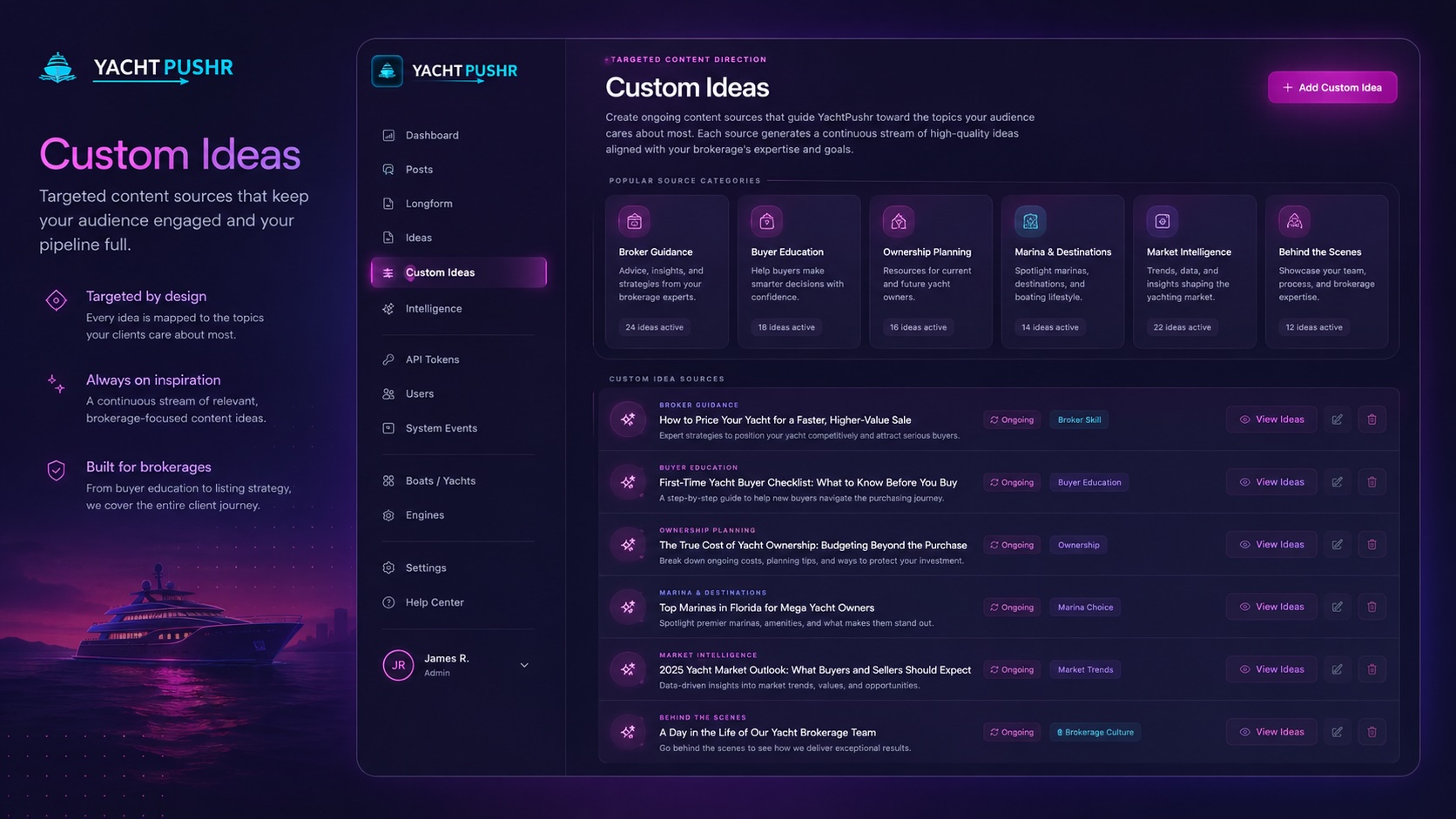
YachtPushr Custom Ideas screen for a brokerage, with Broker Guidance and Buyer Education directions
Custom Ideas

Keep the buyer and seller content coming.

Custom Ideas are standing directions for what YachtPushr writes about. A brokerage might run one for Buyer Guidance, one for Seller Guidance and one for Objection Handling - the questions that stall deals.

Each idea can become an article, a social post or both, and you choose which ones go out. There’s more on how ideas are picked on the AI Content Ideas page.

Winning listings

Use your marketing to win listings.

The best listing pitch is showing an owner what you already do for the boats you have. Pull up the listing posts, the articles and the way your brokerage shows up week after week. That’s a lot more convincing than telling them you market aggressively.

It helps even more if you’ve already written about the kind of boat they own. An article on what buyers look for in their make and model shows you know the market before you say a word about price.

YachtPushr keeps that going without anyone on your team having to remember it. Every boat you list gets marketed the same way, and the articles build up into a library you can send owners to. If listing promotion is your main focus, our page on yacht listing marketing goes deeper, and if you’re weighing software against hiring an agency, our yacht marketing guide covers that choice.

Questions

Questions from yacht brokers.

Does YachtPushr work with our MLS?

+

Yes. We very likely already connect to it, so YachtPushr syncs your listings straight from your MLS. If yours isn’t supported yet, we build the connection for you, usually within days. Specs and photos come in with the sync.

Can it post our listings to social media?

+

Yes. Listing posts go out across your social media, including carousels and video, alongside your general brokerage posts.

Can several brokers in our office use it?

+

Yes. A brokerage can have multiple users working in the same account.

Will the posts and articles sound like AI wrote them?

+

No. YachtPushr is designed to sound like your brokerage, not like AI, and everything it publishes stays within Google’s and Bing’s content policies. Nothing goes out until someone on your team approves it.

How is YachtPushr priced for a brokerage?

+

It depends on the size of your brokerage and what you need it to do. We’ll go through it on a demo call.

See YachtPushr

Let YachtPushr learn your business.

Tell us what you do and where you work. We’ll show you what YachtPushr would write, where it would publish and how you’d see the results.

Request a Demo
Tell us a little about yourself and your business.
JR
About the author

James Rissler

James builds YachtPushr and runs Sophisticated Yachting, a charter company that went from no bookings to busy using the same platform. He also does yacht deliveries, so he sees marine marketing from both sides of the dock: as the person writing the software and as the person who needs the phone to ring.