
Website Publishing Without the Chaos: A Simple Structure That Turns Content Into Discoverable Assets
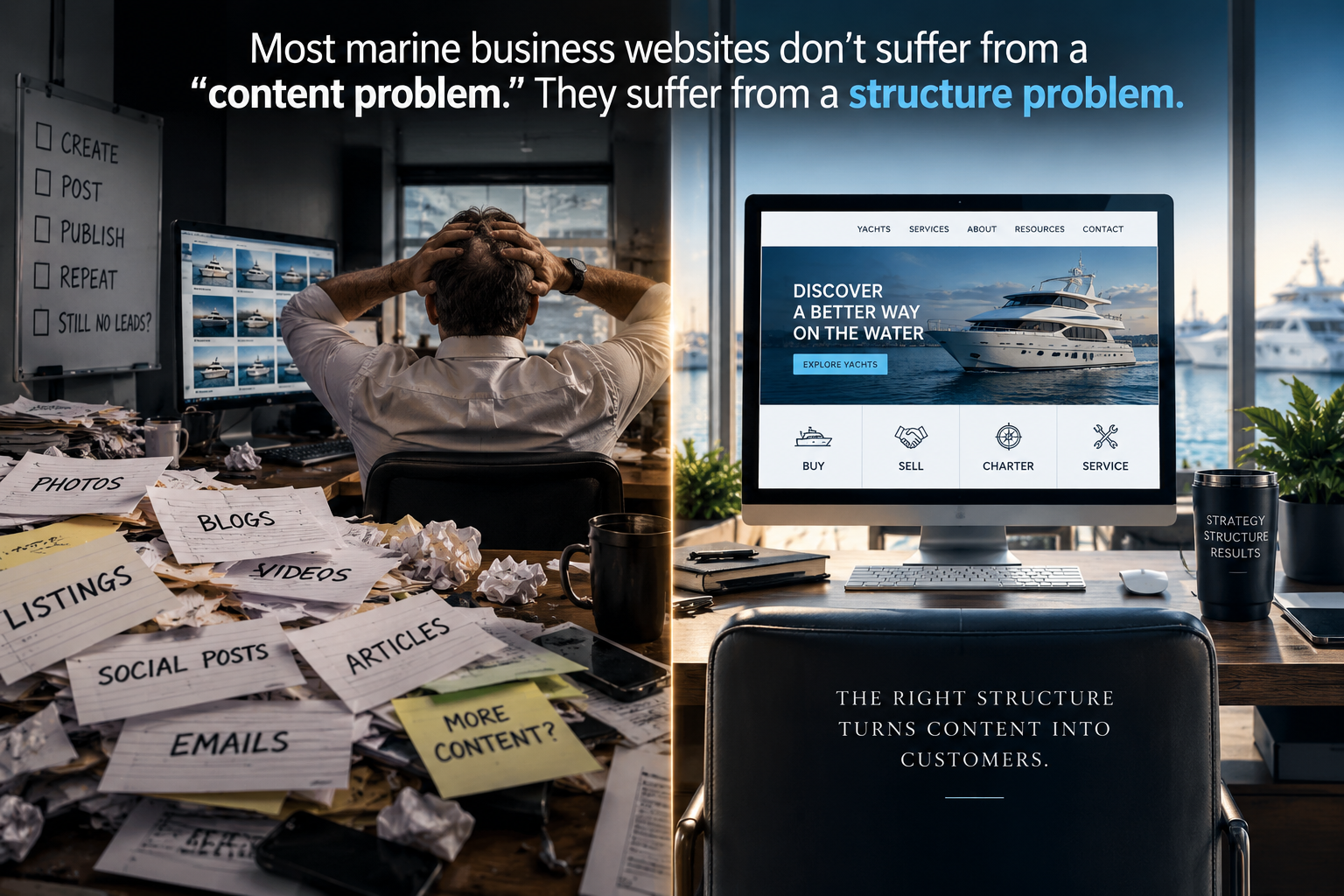
Most marine business websites don’t suffer from a “content problem.” They suffer from a structure problem.
Over time, blogs become junk drawers: random listings, announcements, SEO posts, staff updates, boat show recaps, and one-off ideas all thrown into the same bin. Nothing is easy to find. Search performance plateaus. New content doesn’t move the needle.
The fix isn’t “more content.” It’s a simple, intentional site structure that turns every piece of content into a discoverable asset—and a marketing platform that keeps that structure intact as you grow.
Below is a practical model tailored to yacht brokers, charter companies, marinas, and marine service businesses—and how YachtPushr helps you manage it without chaos.
The Core Page Types Every Marine Site Needs
Think of your site not as one blog, but as a small set of page types, each doing a specific job.
1. Core Service & “Who We Are” Pages
These are the pages that explain:
- What you do (brokerage, charter, management, refit, marina, service)
- Who you serve (regions, vessel types, customer profiles)
- Why you’re different (experience, specialties, process, track record)
Examples:
- “Yacht Sales – Fort Lauderdale”
- “Catamaran Charters in the BVI”
- “Full-Service Marina & Yard – Pacific Northwest”
- “Yacht Management & Guardianage”
These pages should:
- Be tightly focused on a single service or area
- Use plain-language keywords your clients actually search
- Link out to relevant inventory, locations, and in-depth articles
YachtPushr’s role:
YachtPushr helps define and maintain a consistent structure for these pages, ensuring your key services and locations are clearly presented, interlinked, and supported with fresh content and media—not buried under years of blog posts.
2. Inventory & Offering Pages
For many marine businesses, inventory and offerings are the heartbeat of the website:
- Brokerage listings
- Charter yachts and itineraries
- Slips, storage, and marina services
- Standard service packages or programs
These pages should:
- Follow a consistent template (specs, photos, descriptions, location, key benefits)
- Link up to the appropriate service pages (e.g., “Yacht Sales – Miami”)
- Link sideways to educational content that answers common questions
Examples:
- A specific yacht listing (“2020 Sunseeker Predator 60”)
- A charter yacht profile plus sample itineraries
- “Premium Dry Storage – 30ft and Under”
YachtPushr’s role:
YachtPushr can help synchronize listing data and coordinate descriptions, photos, and SEO text so inventory pages stay up-to-date, properly formatted, and fully connected to the rest of your site instead of existing as isolated islands.
3. Educational Articles & Guides (Your Real “Content Engine”)
This is where most blogs go off the rails. Educational content should answer real buyer questions, not just exist to “feed the algorithm.”
Marine-specific examples:
- “Buying a Yacht in Florida vs. the Mediterranean: What Changes?”
- “What Actually Happens During a Marine Survey?”
- “How to Choose Between Bareboat and Crewed Charter”
- “Five Ways to Protect Your Hull Finish in Tropical Marinas”
These articles should:
- Link to relevant service/location pages (e.g., “See our yacht management services in Palma”)
- Link to supporting content (e.g., a deeper guide on refit timelines)
- Be written for humans first, with clear headings and natural keywords
YachtPushr’s role:
YachtPushr creates and organizes educational content aligned with your real expertise, services, and audience—not generic prompts. The platform:
- Suggests topics based on search demand and your existing content gaps
- Drafts articles in your brand voice with clear SEO structure
- Connects each article to the right service pages and inventory for internal linking
- Uses YachtPushr Intelligence to show which topics actually attract qualified visitors
4. Location & Destination Pages
If geography matters to your business, dedicated pages are critical:
- “Yacht Brokerage – Annapolis”
- “Crewed Charters – St. Martin”
- “Marina & Yard – Savannah River”
These pages should:
- Explain what you do in that specific location
- Highlight local nuances (regulations, seasons, marinas, cruising grounds)
-
Link to:
- Relevant inventory/offerings in that region
- Articles about cruising, owning, or chartering in that area
- Your main service pages
YachtPushr’s role:
YachtPushr helps you build a consistent framework for location pages and automatically connect new articles, listings, and updates to the right geographic hub for stronger local SEO and easier navigation.
5. Authority & Proof Pages (Trust Builders)
Marine buyers are high-consideration. They want proof:
- Case studies
- Owner stories
- Notable projects or refits
- Awards, certifications, associations
- Press mentions and speaking engagements
These pages should:
- Use real photos, real timelines, and specific results
- Link naturally to relevant service pages (“This refit was managed by our Palma team”)
- Be easy to update as new wins come in
YachtPushr’s role:
YachtPushr streamlines gathering, drafting, and publishing proof content so it doesn’t sit in someone’s inbox. It also connects those stories to the right services and locations, turning testimonials into discoverable, SEO-friendly assets.
How to Link These Page Types for Strong Marine SEO
Once you have the right page types, the next step is deliberate linking. Done well, it helps search engines understand your expertise—and helps visitors naturally progress toward contacting you.
A simple, effective structure:
-
Service Pages as Hubs
-
Each core service page links to:
- Key educational articles that support that service
- Relevant location pages
- Representative inventory or offerings
-
Example:
“Yacht Management” → articles about maintenance planning, cost breakdowns, insurance considerations → “Yacht Management – Fort Lauderdale” → example managed yachts.
-
Each core service page links to:
-
Educational Articles as Bridges
-
Each article links:
- Upward: to a primary service or location page (“If you’re planning a Med season, explore our charter management services”)
- Sideways: to related articles (“For more detail on crew hiring, read this guide”)
- Occasionally: to specific inventory or offerings when relevant
- This transforms the “blog” from a pile of posts into a web of helpful resources.
-
Each article links:
-
Location Pages as Local Anchors
-
Location pages link to:
- Locally relevant services and offerings
- Articles written with that geography in mind
- Local proof (case studies, events, projects)
- This tells search engines: “We truly operate and have depth here.”
-
Location pages link to:
-
Inventory Pages as Converters
-
Listing/offer pages link to:
- The broader service page (e.g., “View all yacht sales services”)
- Related educational content (e.g., “First-time buyer guide”)
- When those educational pieces already point back to service pages, you’ve created a clean, reinforcing structure.
-
Listing/offer pages link to:
YachtPushr’s role:
YachtPushr’s website management features keep these connections organized. When a new article is published, YachtPushr can:
- Suggest which pages it should link to based on topic, location, and services
- Help you ensure key service and location pages are always supported by relevant content
- Flag “orphan” content that isn’t properly linked anywhere and therefore underperforming
Keeping Everything Current—Without Micromanaging Your Site
The real challenge isn’t designing a structure once. It’s keeping it intact as real life happens:
- New listings and charters arrive
- Old offerings expire
- Regulations change by region
- Boats sell before content is updated
- Staff wear many hats and marketing gets deprioritized
This is where a marine-focused platform matters more than yet another CMS plugin.
With YachtPushr:
- Content planning is guided by your services, locations, and inventory—not random topics
- Publishing workflows keep articles, pages, and listings aligned with the structure above
- Inventory synchronization helps ensure your site reflects your real-world offerings
- Website management tools maintain menus, category structures, and key internal links as you grow
-
YachtPushr Intelligence analyzes which pages and topics drive qualified traffic and engagement, then recommends:
- Which articles to update
- Where to add new internal links
- Which locations or services deserve more content investment
You’re not guessing what to publish next or where it should live. You’re following a clear, data-informed map.
Turn Your Website From Junk Drawer to Strategic Asset
When your marine website is built around clear page types, purposeful linking, and consistent structure, every new article, listing, and announcement becomes a discoverable, useful asset—not just another post in the pile.
YachtPushr helps you:
- Define and maintain that structure
- Create content informed by your real expertise and audience
- Connect pages in a way that supports SEO and human navigation
- Use performance data to decide what to publish—and what to improve—next
If you’re ready to turn your website into a disciplined marketing engine instead of a chaotic blog, explore how YachtPushr can support your brokerage, marina, charter operation, or service business. Reach out to our team to see your site through the lens of YachtPushr Intelligence and map your next steps.