We Love Helping Yacht Brokers Succeed.
We’re passionate about supporting brokers in leveraging YachtPushr to streamline their yacht listings and marketing efforts. We're here to guide you every step of the way.
Cutting-Edge Technology
Designed to simplify boat listings, enhance social media, and campaigns.
Streamline Your Process
YachtPushr supercharges your online marketing—saving you time and expanding your reach.
Get in Touch
Have questions or need assistance? Our team will guide you every step of the way.
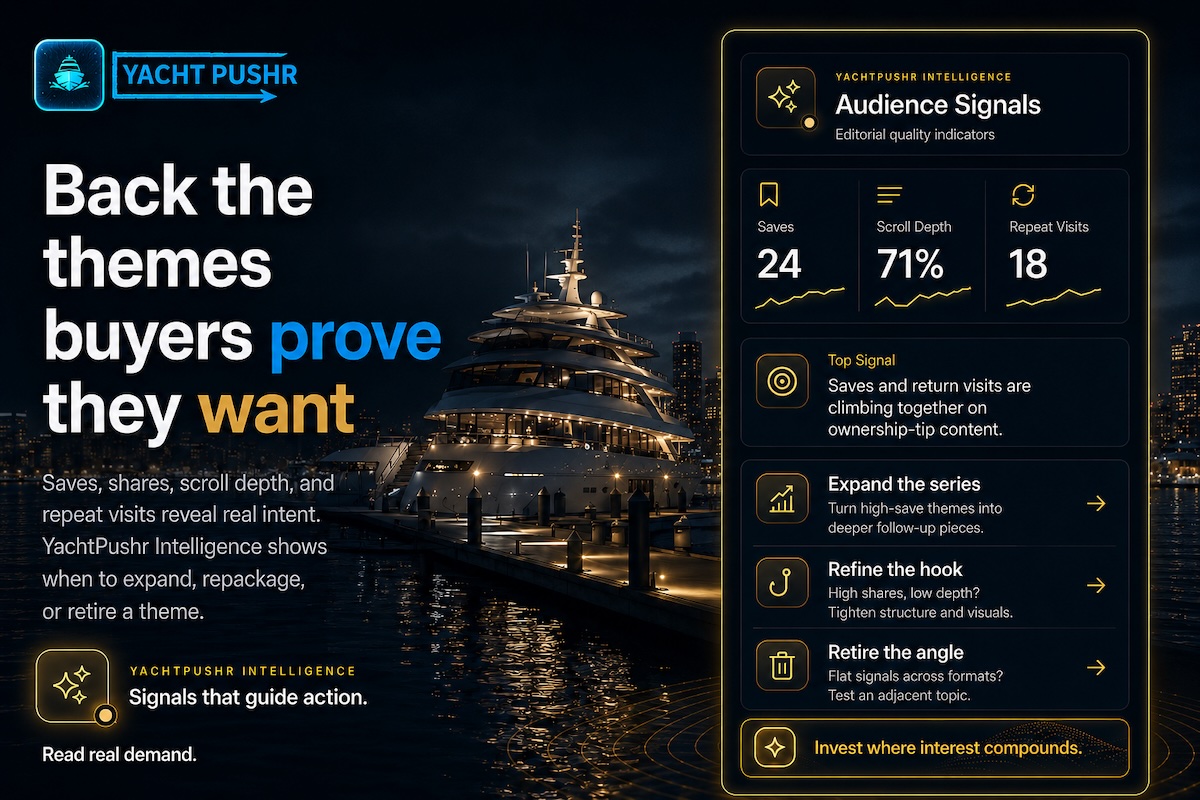
Smarter Editorial Bets: What Audience Signals Really Say About Your Marine Marketing
In yacht brokerage and marine services, your content either attracts qualified buyers—or wastes everyone’s time. The challenge isn’t just “posting more.” It’s knowing what to double down on and what to quietly retire.
That’s where audience signals become invaluable. When you understand what saves, shares, scroll depth, and repeat visits actually mean, you can stop guessing and start making deliberate editorial decisions that move inventory, fill charters, and build your brand.
This article breaks down which behaviors indicate genuine interest and how YachtPushr Intelligence turns those signals into clear next steps for your marketing.
The Four Signals That Actually Matter
Most marine businesses track likes and impressions. Those are surface-level indicators. If you want to judge content quality and editorial themes, focus on these deeper signals:
- Saves
- Shares
- Scroll depth
- Repeat visits
Each one tells you something different about your audience’s intent.
1. Saves: “I’m coming back to this”
A save is one of the strongest signals in social media and content platforms. People only save content they expect to revisit or use.
In a marine context, high saves often point to:
- Guides that help buyers understand a segment (e.g., “Center Consoles vs. Walkarounds for Offshore Fishing”)
- Checklists and how-tos (pre-purchase inspections, seasonal maintenance, charter prep)
- Market insights and pricing explanations
What saves usually mean for you:
- This topic is highly useful and “evergreen”
- Your audience sees you as a reference, not just an advertiser
- There’s likely room to expand this theme into deeper or more specific pieces
2. Shares: “My network needs to see this”
A share is social proof at work. It tells you the content resonates strongly enough that someone is willing to attach their reputation to it.
For yacht brokers and marine businesses, high shares often signal:
- Strong emotional resonance (dreaming about a lifestyle, destination, or ownership experience)
- Clear articulation of a problem or frustration your audience recognizes
- Content that makes the sharer look informed or helpful
What shares usually mean for you:
- This topic has branding power—it spreads your name into new circles
- It’s a strong candidate for ad amplification or turning into a recurring series
- Variations (format, segment, region) are likely to perform well
3. Scroll Depth: “I’m actually reading this”
Scroll depth (how far someone gets through a page or article) is a direct indicator of engagement quality—far more useful than simple pageviews.
For long-form content like buying guides, market reports, or destination features:
-
High scroll depth + normal time on page
→ The content is digestible and compelling. -
Low scroll depth + high bounce
→ The topic or opening may be wrong for your audience—or the format is off. -
High scroll depth on mobile
→ The content is genuinely strong; mobile readers are quick to abandon weak content.
What scroll depth usually means for you:
- Which topics justify long-form investment
- Where readers drop off (poor structure, late calls to action, unnecessary fluff)
- Which pieces should be repurposed into social posts, video scripts, or email series
4. Repeat Visits: “You’ve earned a place in my routine”
When someone keeps coming back to your content, it suggests you’ve crossed the line from vendor to trusted source.
In marine businesses, repeat visits often correlate with:
- Longer purchase journeys (e.g., larger yachts, new-to-boating buyers)
- Ongoing needs (service, management, seasonal storage, refit projects)
- High-trust decisions (charter programs, management contracts)
What repeat visits usually mean for you:
- You can safely invest in deeper education: series, reports, and recurring segments
- There’s an opportunity to position ongoing services, not just one-time transactions
- Themes attracting repeat visitors deserve higher visibility across channels
Deciding When to Double Down—or Move On
You don’t need to obsess over every metric. Use these simple patterns to guide editorial choices.
When to Double Down on a Theme
Consider a theme “proven” when you see:
- High saves or shares relative to your typical content
- Strong scroll depth (e.g., 60–80%+ of the page) on articles
- Repeat visitors landing on multiple pieces in the same category
- Steady performance across formats (social posts, blog, email clicks)
Double down by:
- Creating a series around the topic
- Segmenting further (by budget, vessel type, use case, region)
- Turning text into visual assets (carousels, short videos, gallery posts)
- Featuring the theme more prominently on your website and social calendar
When to Retire or Rethink a Theme
A theme might need to be retired—or significantly reworked—if you see:
- Consistently low scroll depth and high bounce
- Very few saves or shares despite regular posting
- Weak performance across multiple formats and channels
- No correlation with valuable behaviors (inquiries, inventory views, service pages)
Before you abandon it entirely:
- Test a sharper angle (“Costs” vs. “Features,” “Mistakes to Avoid” vs. “How-To”)
- Shorten the format or break a long topic into a series
- Improve the lead image, headline, or hook to better match your audience’s reality
Where Most Marine Businesses Get Stuck
The real problem isn’t understanding that saves or scroll depth matter. It’s turning dozens of metrics across multiple platforms into clear editorial decisions.
Common roadblocks:
- Data is scattered across social networks, your website, and email tools
- No time to analyze trends; everyone is busy selling, managing, or operating
- Editorial decisions are based on personal opinion, not audience behavior
- Good ideas get buried because there’s no system to spot and scale them
This is exactly the gap YachtPushr was built to close.
How YachtPushr Intelligence Turns Signals into Strategy
YachtPushr brings your marine content, publishing, and performance data into one platform, then uses YachtPushr Intelligence to translate audience signals into practical next actions.
Here’s how that plays out in real life:
1. Connecting Your Content and Signals
YachtPushr monitors how your themes perform across:
- Social posts (including saves, shares, and basic engagement)
- Blog and web content (scroll depth, time on page, paths)
- Audience behavior over time (repeat visits, content clusters)
Instead of dashboards full of raw metrics, you see:
- Which topics your buyers return to
- Which posts reliably earn saves and shares
- Which articles hold attention all the way through
2. Identifying Themes to Amplify
YachtPushr Intelligence flags content patterns such as:
- “Mid-size sportfishing guides show above-average scroll depth and repeat visits—consider expanding this editorial lane.”
- “Posts explaining operating costs are saved at 2x your average—create more cost-transparency content.”
- “Charter itinerary pieces are highly shared but short—test long-form versions or destination series.”
The platform doesn’t just show you that a post “did well”—it helps you see why and what to do next.
3. Recommending Specific Next Actions
Based on these signals, YachtPushr can suggest and help execute concrete steps, such as:
- “Turn this high-save checklist into a downloadable guide and supporting social series.”
- “Create three follow-up posts exploring the most-read section of this article.”
- “Elevate this theme into a recurring monthly feature across your channels.”
Because YachtPushr also handles planning, content creation, scheduling, and publishing, you’re not left with a strategy you don’t have time to implement—the system helps you do the work.
4. Knowing What to Quietly Retire
On the other side, YachtPushr Intelligence will surface:
- Underperforming themes that consistently fail to earn saves, shares, or depth
- Topics that only perform on one channel but not others
- Content formats your audience doesn’t respond to
From there, you can:
- Reduce publishing frequency for weak themes
- Reframe or reposition a topic that might still matter strategically
- Reallocate your effort to editorial lanes that consistently produce interest
Make Every Post a Smarter Bet
Marine buyers and owners leave clues constantly. Saves, shares, scroll depth, and repeat visits are your signal lights—telling you what to explain, what to expand, and what to let go.
You don’t need more random content. You need a system that:
- Reads these signals across channels
- Translates them into clear editorial direction
- Helps you execute the next best piece—without adding to your workload
That’s what YachtPushr was built to do for yacht brokers, charter operators, marinas, management firms, and marine service businesses.
If you’re ready to make smarter content investments and let your audience guide your editorial strategy, explore YachtPushr or contact us to see how YachtPushr Intelligence can support your marine marketing.