We Love Helping Yacht Brokers Succeed.
We’re passionate about supporting brokers in leveraging YachtPushr to streamline their yacht listings and marketing efforts. We're here to guide you every step of the way.
Cutting-Edge Technology
Designed to simplify boat listings, enhance social media, and campaigns.
Streamline Your Process
YachtPushr supercharges your online marketing—saving you time and expanding your reach.
Get in Touch
Have questions or need assistance? Our team will guide you every step of the way.
How to Use Data Analytics to Improve Your Yacht Brokerage Business
High-end buyers and sellers expect expertise, speed, and a premium digital experience. Data analytics helps yacht brokers deliver all three. By tracking the right metrics across listings, channels, and audiences—and turning insights into action—you can accelerate deal flow, sharpen your marketing, and protect margins. Here’s how to make analytics a growth engine for your yacht brokerage.
Why data analytics matters in yacht brokerage
Yacht transactions have long sales cycles, complex decision pathways, and a fragmented marketing landscape (YachtWorld, social platforms, Google, email, events). Without unified analytics, it’s easy to waste spend, miss serious buyers, or over-price inventory. Data closes the gap by:
- Revealing what actually drives qualified inquiries
- Identifying the content and channels that move prospects down-funnel
- Optimizing listing presentation, timing, and pricing strategy
- Eliminating manual reporting so you can focus on relationships
The metrics yacht brokers should track
Focus on signals that map to pipeline quality and velocity, not vanity.
- Listing visibility: impressions, reach, search position (YachtWorld, Google)
- Engagement: saves/favorites, shares, click-through rate (CTR) to listing pages
- Conversion: inquiries, form submits, calls, booked showings
- Channel performance: source of lead by platform (Instagram Reels vs. LinkedIn vs. Google Business)
- Audience insights: geography, interests, age brackets aligned with price tiers
- Speed-to-lead: response time, follow-up cadence, meeting set rate
- Deal progression: days on market, price changes vs. inquiry spikes
- Cost metrics: cost per lead (CPL), cost per booked showing, marketing ROI
Pro tip: Track “micro-conversions” like saves/favorites and video watch time. These predict inquiries and help you refine creative before you change pricing.
Listing performance analytics: build listings that convert
Small creative changes can produce outsized gains.
- Test your hero media: Compare lead image angles (bow-on vs. lifestyle) and early Reels thumbnails; monitor CTR and saves.
- Strengthen headlines: Include year, model, key differentiator, and location. Watch search visibility and click-through.
- Refine descriptions: Group specs, upgrades, maintenance records, and owner history for scanability. Track time-on-page and inquiry rate.
- Optimize timing: Identify posting windows when your audience is most active; watch for inquiry bursts within 24–72 hours.
If a listing gets high impressions but low saves and inquiries, you likely have a positioning or creative gap—fix photo order and headline before considering a price reduction.
Audience and channel insights: invest where buyers are
Not all platforms drive the same outcomes.
- Instagram/TikTok: Top-of-funnel reach and lifestyle engagement; short videos and walkthroughs work well.
- YachtWorld: High-intent traffic; prioritize spec clarity and pro photos.
- LinkedIn: Broker credibility, B2B partnerships, fleet and management updates.
- Google Business: Local discovery for showings, marina visits, and service inquiries.
Use analytics to map platform to outcome. For example, if Instagram yields the most saves but YachtWorld drives the most inquiries, design a two-step journey: short-form video for awareness, then push to the listing for conversion.
Content analytics for brand building
Brand trust is a leading indicator in high-ticket decisions.
- Balance content types: listings, market insights, behind-the-scenes, owner stories, and broker tips.
- Track engagement by theme: which posts earn shares and saves among qualified buyers?
- Measure consistency: posting cadence correlates with inquiry stability—avoid dead zones.
Turn insights into action
Data only matters when it drives decisions. Create a monthly optimization rhythm:
- Refine targeting: Shift spend toward geographies and interests tied to actual inquiries.
- Upgrade creative: Replace underperforming hero images; add short video tours; include key specs in the first three seconds.
- Improve response speed: Set an internal SLA (e.g., under 10 minutes during business hours) and monitor it.
- Re-sequence content: Lead with lifestyle hook, follow with specs, finish with a strong CTA and easy contact paths.
- Adjust pricing strategically: Use saves-to-inquiry ratio and days on market to inform timing—not guesswork.
- Nurture warm interest: Retarget users who watched 50%+ of a video or saved a post with a follow-up carousel or market update.
Build an analytics workflow in YachtPushr
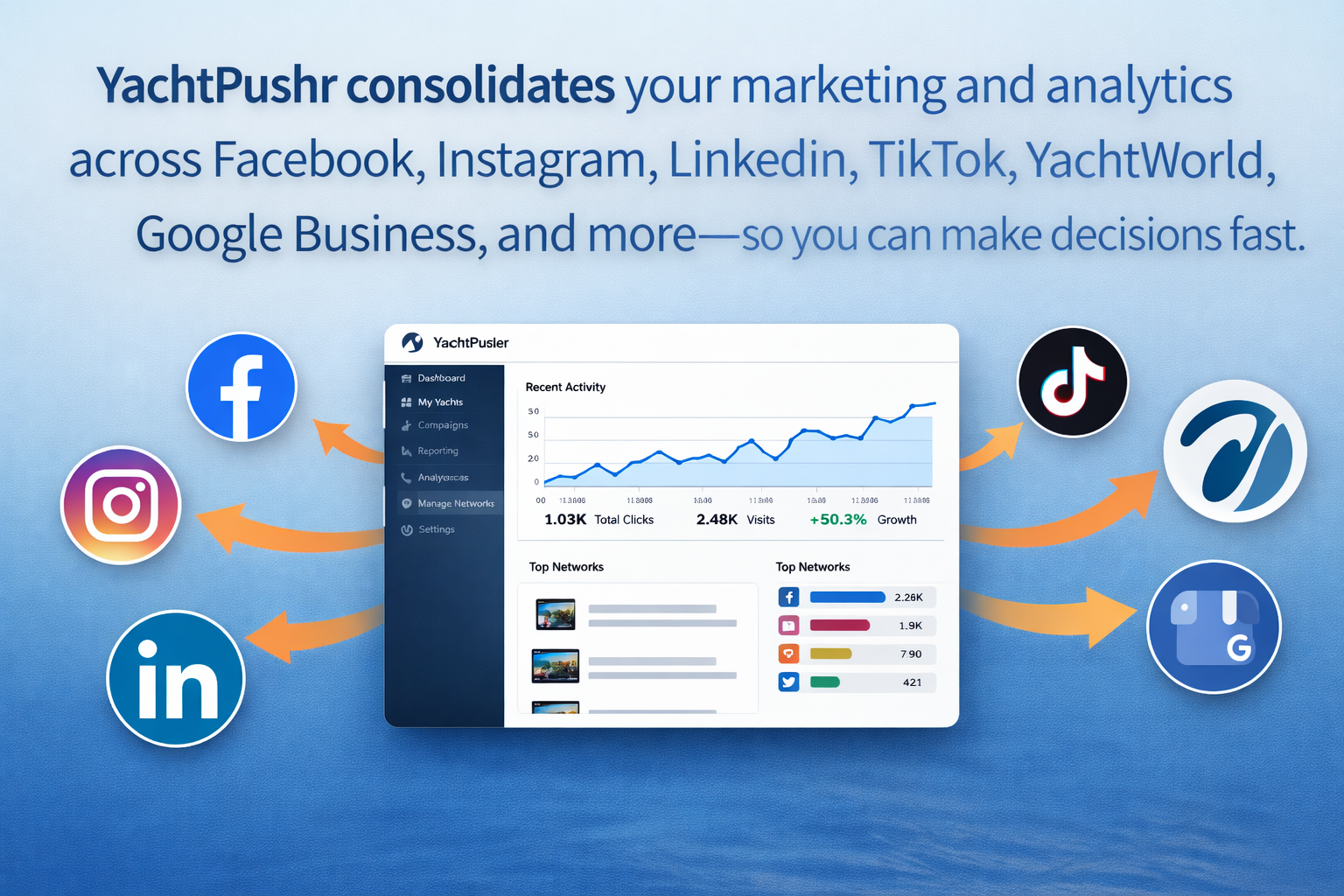
YachtPushr consolidates your marketing and analytics across Facebook, Instagram, LinkedIn, TikTok, YachtWorld, Google Business, and more—so you can make decisions fast.
-
Set objectives
- Define KPIs per listing (inquiries, booked showings) and per channel (CTR, saves).
- Tag goals for broker branding vs. listing promotion.
-
Centralize insights
- Use YachtPushr’s unified dashboard to view impressions, engagement, and audience trends across platforms in one place.
- Compare channel performance side-by-side to spot winners and underperformers.
-
Let AI accelerate creative
- Generate marine-optimized captions and imagery tailored to platform algorithms.
- Maintain luxury-grade branding while scaling output for multiple listings and campaigns.
-
Schedule and sequence
- Plan a cadence that mirrors buyer behavior (e.g., YachtWorld refresh in the morning; Reels in the evening).
- Automate distribution so every listing gets consistent coverage.
-
Review and iterate weekly
- Identify listings with high reach but low inquiries; adjust creative.
- Double down on content themes with above-average saves and shares.
- Log lead sources in your CRM and compare to YachtPushr analytics for full-funnel clarity.
-
Report without the grind
- Replace manual spreadsheets with YachtPushr’s real-time analytics views for owners and team meetings.
Quick wins to implement this quarter
- Standardize hero image guidelines and captions across all listings.
- Publish one 20–40 second walkthrough video per active listing each week.
- Track saves-to-inquiry ratio and set thresholds for creative refresh vs. price review.
- Reallocate 20% of budget monthly from lowest-ROI channel to highest-ROI channel.
- Establish a sub-10-minute lead response SLA and measure it.
- Use YachtPushr to schedule a consistent, cross-platform content calendar and review analytics every Friday.
Data-driven marketing doesn’t replace relationships—it amplifies them. When your brokerage uses analytics to show up with the right message, in the right place, at the right time, you win attention and accelerate deals.
Ready to turn insights into impact? Book a YachtPushr demo and see how AI-driven marketing and real-time analytics can power your yacht brokerage.